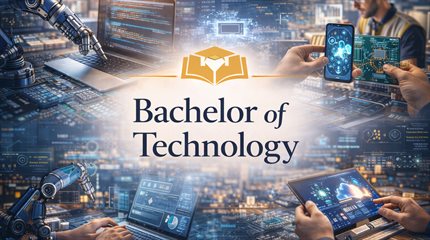
Bachelor of Technology | B.Tech
Course Overview – B.Tech (4 Years)
The Bachelor of Technology (B.Tech) in Civil Engineering is a foundational undergraduate program designed to provide students with a robust understanding of the principles and practices involved in the planning, design, construction, and maintenance of infrastructure projects. This program delves into various specializations within civil engineering, ensuring graduates are well-prepared for the challenges of the modern construction industry.
Key areas covered include structural engineering, geotechnical engineering, transportation engineering, water resources engineering, and environmental engineering, utilizing modern analytical tools and design software.
This course is ideal for students with a strong aptitude for mathematics and physics, who are interested in building and shaping the physical world around them, and who aspire to contribute to societal development through infrastructure creation.
What Is This Program All About?
This program provides a comprehensive education in the core disciplines of civil engineering. Students will gain theoretical knowledge and practical experience in designing and managing a wide range of infrastructure projects, from buildings and bridges to roads and water systems.
You will learn to:
- Analyze structural integrity and design safe and efficient buildings and bridges.
- Understand soil mechanics and foundation design for various construction projects.
- Plan and design transportation networks, including roads, railways, and airports.
- Manage water resources, including supply, treatment, and distribution systems.
- Address environmental concerns in construction and develop sustainable solutions.
- Utilize CAD software for design and project management tools for execution.
- Ensure compliance with building codes and safety regulations.
- Lead and manage construction teams and projects effectively.
Tools & Technologies Covered
| Technology | Purpose |
|---|---|
| AutoCAD | 2D and 3D drafting and design |
| Revit | Building Information Modeling (BIM) |
| STAAD.Pro | Structural analysis and design |
| ANSYS | Finite element analysis |
| MS Project | Project planning and management |
| GIS Software | Geographic Information Systems for spatial analysis |
| Surveying Equipment | Land surveying and site analysis |
| Concrete Testing Equipment | Material property assessment |
Industry-Focused Learning Approach
- Hands-on laboratory sessions for material testing and analysis.
- Site visits to ongoing construction projects for practical exposure.
- Case studies of real-world engineering challenges and solutions.
- Group projects simulating team-based engineering tasks.
- Internships with leading construction and engineering firms.
- Guest lectures by industry experts and practicing engineers.
🌟 Why Choose This Course?
The Bachelor of Technology (B.Tech) is more than just an academic degree — it’s a gateway to innovation, impact, and financial independence. From the booming Indian startup ecosystem to global tech giants, engineers are in massive demand across industries, and the B.Tech program remains the most reliable pathway to build a rewarding, future-proof career.
💼 Career Potential & Industry Demand
Engineering is the backbone of every industry — whether it’s building bridges, apps, satellites, or AI-powered chatbots. With the surge in digital transformation, automation, and sustainable tech, B.Tech graduates are driving change at every level.
In India alone:
-
Over 1.5 million engineers graduate every year
-
The IT & engineering sector contributes 7.5%+ to GDP
-
B.Tech remains the #1 degree choice for PSU recruitment, global placements, and startup hiring
Globally, countries like Canada, USA, Germany, and Australia are actively recruiting Indian B.Tech graduates through STEM immigration routes, international internships, and remote jobs.
💡 Whether you want to build the next AI startup or crack the GATE exam for PSUs, B.Tech is a proven path to both industry and academic excellence.
🎓 ScholarIQ Value-Add: Beyond the Classroom
At ScholarIQ, the B.Tech program is enhanced with tools, mentorship, and project-based learning that prepares students not just to graduate, but to excel professionally.
🧑🏫 Virtual Mentorship Program
-
Connect with alumni & engineers from TCS, Bosch, Microsoft, ISRO
-
Get help with coding, research, GATE prep, and project reviews
📚 Smart LMS Platform
-
AI dashboards track performance, skill gaps & suggest learning paths
-
Virtual coding labs, quizzes, simulations, 3D models & gamified content
🛠 Internship & Hackathon Support
-
Partnered with 60+ recruiters and innovation labs
-
Support for Smart India Hackathon, IEEE, DRDO, AICTE competitions
🧪 Capstone Projects + GitHub Portfolios
-
Build full-stack apps, hardware models, simulations, or hybrid systems
-
Submit real-world engineering projects on GitHub for employers to review
🛠 ScholarIQ bridges the industry-academia gap by equipping you with practical experience, digital exposure, and career acceleration.
🚀 Top Recruiters & Roles
B.Tech graduates are recruited across MNCs, government PSUs, startups, R&D centers, and even IIT-incubated ventures.
💼 Popular Recruiters:
-
IT/Tech: Infosys, TCS, Wipro, HCL, Capgemini, IBM, Google, Amazon
-
Core Engineering: L&T, Tata Steel, BHEL, Siemens, NTPC, ISRO
-
Consulting/Analytics: Deloitte, Accenture, ZS, EY
-
Startups: Ola Electric, Razorpay, BYJU’S, Zoho, Zomato, InMobi
🎯 Top Job Roles:
-
Software Engineer, Full Stack Developer, DevOps Associate
-
Design Engineer, Control Systems Engineer, Project Engineer
-
Civil Site Engineer, Construction Analyst
-
Electrical Design Engineer, IoT Specialist
-
Data Analyst, AI/ML Engineer
-
R&D Engineer (Mechanical/ECE)
🎓 B.Tech also opens doors to:
-
MBA (via CAT), M.Tech (via GATE), UPSC, CDS, AFCAT
-
Higher studies in the US, UK, Germany (with GRE/IELTS)
🌐 Market Alignment: India + Global Trends
B.Tech is fully aligned with the current and future demands of the job market — both in India and abroad:
| Market | Key Trends |
|---|---|
| 🇮🇳 India | Electric Vehicles, Smart Cities, 5G/6G, AI, UPI Expansion |
| 🌍 Global | Green Infrastructure, AI Robotics, Satellite Internet, Cybersecurity |
| 💻 Freelance & Remote | Web/App Dev, Product Design, Embedded Systems |
According to NASSCOM and WEF, 65% of today's school students will work in jobs that don't exist yet — and B.Tech trains you to adapt, innovate, and lead in such a future.
✅ Why Choose B.Tech with ScholarIQ?
Here are 6 reasons why this program is perfect for future-ready learners:
-
✅ Industry-Ready Curriculum
– Designed with input from IIT alumni, corporate leaders & edtech advisors -
📊 Hands-on Projects
– Real-world engineering simulations, coding labs & GitHub portfolios -
💼 High-Paying Job Roles
– Earn ₹4–12 LPA in tech, core, or consulting roles post-graduation -
🌍 Global Certifications
– AWS, AutoCAD, Python, MATLAB, Cloud Engineer badges -
🎓 Smart LMS Tools
– AI-powered dashboards, 3D visualizations, MCQ + coding test prep -
🧠 Analytical & Strategic Thinking
– Learn problem-solving, systems thinking & design engineering mindset
🧩 Bonus Advantage:
ScholarIQ prepares you for a hybrid tech world, where being a mechanical engineer doesn’t mean staying away from software, and being a coder doesn’t mean skipping electrical basics.
👉 Cross-disciplinary projects like:
-
AI-powered drones
-
IoT-based irrigation systems
-
Energy-efficient smart buildings
-
Mobile-based health diagnostics
…all bridge departments — just like real-world companies do.
🎯 Final Takeaway
If you're dreaming of solving real problems, working with cutting-edge tech, and building your own future, a B.Tech degree powered by ScholarIQ's ecosystem is your smartest choice.
With world-class learning tools, internships, industry mentors, and global-ready skills — your engineering career starts right here.
📘 General Syllabus
📅 Duration: 4 Years (8 Semesters) | 🏫 Format: Credit-Based, Outcome-Oriented | ⚙️ Mode: Classroom + Virtual Labs + Field/Project Work
The B.Tech curriculum follows a multidisciplinary, specialization-based model with increasing technical depth across semesters. It includes core engineering subjects, specialization electives, industry-aligned projects, and a capstone or internship in the final year.
📖 Semester-Wise Structure
🧩 Year 1 – Foundation & Engineering Fundamentals
| Semester | Key Subjects |
|---|---|
| Semester 1 | Engineering Mathematics I, Physics/Chemistry, Basic Electrical & Electronics, Engineering Graphics, Communication Skills |
| Semester 2 | Engineering Mathematics II, Programming in C/Python, Basic Mechanical Engineering, Environmental Studies, Workshop Practices |
🎯 Focus: Build core concepts across disciplines, strengthen logic, creativity & design thinking.
⚙️ Year 2 – Core Technical Concepts
| Semester | Key Subjects |
|---|---|
| Semester 3 | Data Structures, Digital Electronics, Thermodynamics/Fluid Mechanics, Object-Oriented Programming, Discrete Mathematics |
| Semester 4 | Control Systems, Signals & Systems, Operating Systems, Database Management Systems, Introduction to AI/ML (Bridge Course) |
🎯 Focus: Develop problem-solving, design & computational skills through hands-on labs and coding tasks.
🛠 Year 3 – Specialization + Minor Electives
Students choose a specialization stream in their 5th semester. Each stream includes 2–3 core electives and 2 open electives from interdisciplinary areas.
🔹 Core Subjects (Generic Across Streams):
-
Compiler Design / Embedded Systems
-
Software Engineering / Structural Design
-
Data Communication / Power Electronics
-
Industry-Oriented Mini Project I & II
🔸 Electives by Specialization:
| Specialization | Elective Examples |
|---|---|
| 💻 Computer Science (CSE) | 1. AI & Neural Networks, 2. Blockchain Development |
| ⚙️ Mechanical Engineering | 1. Robotics & Mechatronics, 2. CNC Machine Programming |
| 📡 Electronics & Comm. (ECE) | 1. VLSI Design, 2. IoT System Design |
| 🏗 Civil Engineering | 1. Green Building Technology, 2. GIS & Remote Sensing |
| 🔌 Electrical Engineering | 1. Smart Grid Systems, 2. Electric Vehicle Technologies |
| 🤖 AI & Data Science | 1. Deep Learning using TensorFlow, 2. Big Data Analytics |
🎯 Focus: Students apply knowledge via project-based learning and simulations. Cross-stream electives allow hybrid skill development.
🚀 Year 4 – Internship / Research + Capstone Project
| Semester | Components |
|---|---|
| Semester 7 | Industrial Internship (4–8 weeks), Professional Ethics, Technical Seminar, Elective III |
| Semester 8 | Major Capstone Project, Project Viva, Research Methodology, Elective IV |
📌 Capstone Examples:
-
AI-powered Traffic Management System
-
Smart Irrigation System using IoT
-
Campus Placement App (Full Stack)
-
Earthquake-Resistant Modular Housing Design
-
Blockchain-based Certificate Validation System
🎯 Outcome: Students graduate with a strong GitHub/project portfolio, industry exposure, and a problem-solving mindset.
🛠 Labs, Internships & Industry Integration
-
🧪 Physics, Chemistry, and Workshop Labs (Year 1)
-
💻 Computer Programming & Design Labs
-
⚡ Power Electronics, Control Systems, CAD/CAM, Surveying Labs (as per stream)
-
🏭 Internships with ScholarIQ partner companies & R&D centers
-
🧠 Virtual Labs (NPTEL, IITs, MoE) integrated via ScholarIQ LMS
Frequently Asked Questions
Students with a strong interest in mathematics, physics, and problem-solving, who are passionate about building and shaping the physical world, and aspire to contribute to infrastructure development should enroll in this program.
No prior professional experience is required. However, a strong academic background in 10+2 with Physics, Chemistry, and Mathematics is essential for admission.
The course covers industry-standard tools like AutoCAD, Revit, STAAD.Pro, MS Project, and GIS software, along with practical experience with surveying and material testing equipment.
The program includes extensive laboratory sessions, site visits to construction projects, case studies, group projects, and mandatory internships to provide hands-on experience.
Yes, the program typically includes placement assistance services, such as resume building, mock interviews, and connections with industry partners for job opportunities.
Graduates can pursue roles such as Junior Civil Engineer, Site Engineer, Structural Designer, Geotechnical Engineer, Transportation Engineer, and Project Manager.
Freshers in Civil Engineering in India can expect an average salary ranging from INR 3.0 to 4.5 LPA, depending on the company and location.
With experience, Civil Engineers see significant salary growth. Mid-level roles (3-5 years) can earn INR 7.0 - 10.0 LPA, while senior positions (5+ years) like Project Managers can earn INR 10.0 - 18.0+ LPA.
The demand for Civil Engineers in India is consistently high due to ongoing infrastructure development, smart city projects, and government initiatives, ensuring excellent future scope.
This program uniquely blends theoretical rigor with practical application through site visits, industry projects, and exposure to cutting-edge technologies, ensuring graduates are job-ready and equipped for future challenges.
10+2 with Physics, Chemistry, and Mathematics (PCM) from a recognized board; qualifying entrance exam like JEE Main required.
Need help? Our counselors are ready
+91 94038 92667